Understanding dimensional weight is essential for U.S. businesses that assume freight costs depend only on actual weight.
That assumption is costing them money.
International carriers, whether moving cargo by air or ocean, rarely charge based on weight alone.
Instead, they use a pricing method called dimensional weight.
This calculation accounts for the space your shipment occupies, not just how heavy it is.
If your cargo is light but bulky, you will pay for the “size” of the box rather than the items inside.
For US businesses moving commercial cargo across borders, mastering this concept is vital.
It is one of the most practical ways to reduce freight costs.
You can save money without changing what you ship or how fast you need it delivered.
What Dimensional Weight Actually Means
Dimensional weight is a pricing calculation used by air and ocean freight carriers to account for the space a shipment takes up.
The logic is straightforward. An aircraft or ocean container has limited capacity.
A large, lightly packed crate still occupies valuable space, even if it weighs very little.
Carriers calculate dimensional weight using a simple formula. Length times width times height, divided by a carrier-specific dimensional factor.
If the dimensional weight exceeds the actual weight, the carrier charges based on dimensional weight instead.
For air freight, this is called chargeable weight.
For ocean LCL (less-than-container-load) shipments, carriers price by cubic meter. It is the same principle applied differently.
Either way, the result is the same.
Poorly optimized cargo takes up more space than necessary, and your invoice reflects that.
Where B2B Shippers Lose Money Without Realizing It
Most businesses learn about dimensional weight the hard way. Their freight invoice arrives,and it is much higher than expected.
Here is where the costs quietly accumulate.
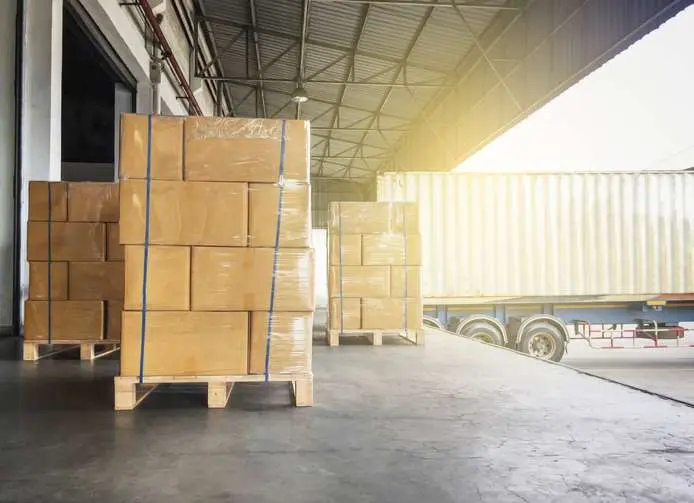
Industrial components shipped in oversized crates with excess internal space. Pallets stacked inefficiently with unused vertical capacity.
Equipment crated with more protective material than necessary, adding cubic volume without adding protection.
Multiple smaller shipments moving separately when consolidation was possible.
Each of these scenarios increases dimensional weight and inflates your freight bill.
For businesses shipping regularly via air or ocean freight, these inefficiencies compound over time.
What seems like a small packaging decision in the warehouse becomes a significant cost driver on the freight invoice.
5 Practical Ways to Reduce Dimensional Weight Costs
The good news is that reducing dimensional weight does not require compromising on cargo protection or delivery speed.
It requires smarter planning.
1. Right-Size Your Crating and Packaging
Match crate and pallet dimensions as closely as possible to the actual dimensions of the cargo.
Excess internal space increases cubic volume and raises dimensional weight calculations.
Experienced crating professionals make a difference. Custom packaging designed around your cargo dimensions pays for itself fast in freight savings.
2. Reduce Internal Void Space
Void space inside crates and containers adds cubic volume without adding protection.
Using form-fitting dunnage, custom foam inserts, or inflatable void fillers keeps cargo secure while minimizing the overall package dimensions.
Less void space means lower dimensional weight.
3. Consolidate Shipments Where Possible
Multiple smaller shipments moving separately each carry their own dimensional weight calculations and handling charges.
A single consolidated shipment costs less than several smaller ones. Chargeable weight drops. Per-unit freight costs follow.
4. Optimize Load Planning Before Booking
How cargo is arranged on a pallet or within a crate directly affects its cubic dimensions.
Efficient stacking, interlocking configurations, and maximizing vertical space all reduce the overall footprint of a shipment.
This is one of the highest-leverage steps in dimensional weight management and one that many shippers overlook entirely.
5. Review Carrier Dimensional Factors Regularly
Different carriers apply different dimensional factors to their calculations.
Air carriers and ocean LCL providers do not all use the same formula.
Different carriers use different dimensional factors. Reviewing these at booking keeps costs predictable.
Working with an experienced freight agent ensures the right carrier is chosen every time.
Why This Matters More for International Freight
Dimensional weight pricing is more consequential for international shipments than domestic ones.
Air freight rates are significantly higher per kilogram than ground transport.
When chargeable weight inflates due to poor packaging, the cost difference is immediate and substantial.
Air freight costs are high.
For industrial components and equipment parts, even modest dimensional weight reductions mean meaningful savings per shipment.
Ocean LCL freight charges by cubic meter.
Every unnecessary centimeter of void space in a crate is a cubic meter fraction you are paying for.
For businesses shipping regularly via ocean freight, optimizing cargo dimensions is one of the most consistent ways to reduce total landed cost over time.
Both modes reward the same discipline.
And that is compact packaging, efficient load planning, and regular review of how cargo is prepared before it moves.
Reducing Dimensional Weight Costs with Jansson LLC Support
Understanding dimensional weight is one thing. Applying it consistently across a global supply chain is another.
Jansson LLC helps U.S. businesses navigate the complexity of international shipping through Landstar’s global network.
As a Landstar freight agent, Jansson connects clients to a full suite of international services.
This includes air freight, ocean freight, customs brokerage, and project cargo. All tailored to commercial freight requirements.
Our team understands how dimensional weight affects freight costs across different carriers and trade lanes.
We help clients identify opportunities to optimize load planning, consolidate shipments, and structure their cargo more efficiently before the invoice arrives.
Jansson covers every step. Documentation, customs clearance, carrier selection, and route optimization are all managed. This allows your international freight costs to stay under control.
Global shipping and logistics solutions should work as hard as the businesses that depend on them.
Contact Jansson LLC today and let’s talk about building a smarter international shipping strategy for your business.