Most shippers treat freight mode selection as a binary choice. LTL for smaller loads. FTL for full trucks. Everything in between gets defaulted to LTL because the pallet count does not feel like enough for a full truck.
That default is costing businesses real money — especially on shipments between 6 and 12 pallets, where the linear foot rule routinely makes LTL more expensive than the alternatives.
Here is the actual cost breakdown — with 2026 rate data — so you can make the decision with numbers rather than assumptions.
The 2026 Rate Environment You Are Working With
LTL contract rates averaged approximately $46.40 per hundredweight in 2026, up roughly 14% year over year. A single pallet typically costs $120 to $250 depending on weight, class, and lane. FTL dry van averages $1.50 to $3.00 per mile, with spot van near $2.05 per mile.
Those baseline numbers are where most shippers start and stop their analysis. The problem is that neither number accounts for what happens when the linear foot rule triggers on an LTL shipment — or when partial truckload becomes the cheaper alternative in the middle range.
What the Linear Foot Rule Actually Does to Your Invoice
LTL carriers price shipments based on weight and freight class — but they also maintain a linear foot threshold beyond which they charge for floor space rather than weight. The threshold varies by carrier. Old Dominion triggers at 10 linear feet. ABF at 15. Most major carriers fall between 10 and 12.
When your shipment crosses the threshold, the carrier applies a minimum weight charge of 1,000 pounds per linear foot. A shipment occupying 16 linear feet gets rated as if it weighs 16,000 pounds — regardless of actual weight.
Here is what that looks like on a real shipment.
The Example: 7 Pallets, Chicago to Atlanta
Seven standard 48×40-inch pallets, 2,100 pounds total, traveling from Chicago to Atlanta — a lane of approximately 720 miles.
The LTL Calculation
Seven pallets arranged in four rows — three rows of two plus one single pallet in the fourth row. Four rows at 4 feet each equals 16 linear feet.
At $46.40 per hundredweight and an actual weight of 2,100 pounds, the base rate would be approximately $97. But the linear foot minimum applies: 16 linear feet at 1,000 pounds per foot equals a minimum rated weight of 16,000 pounds. At $46.40 per hundredweight, the linehaul charge becomes approximately $742 — before fuel surcharge and accessorials.
With a fuel surcharge running near 30% of linehaul in 2026, total LTL cost for this shipment approaches $965 or more.
The Partial Truckload Alternative
Partial truckload — also called volume LTL — charges by space used rather than applying the punitive per-foot minimum. For a 7-pallet shipment on a 720-mile lane, PTL pricing in 2026 typically runs $400 to $550 depending on the carrier and lane.
That is a savings of $400 to $500 on a single shipment — from the same freight, on the same lane, with the same delivery timeline.
Partial truckload is frequently 20 to 40% cheaper than LTL in the 6-to-12-pallet zone, with less handling and lower damage risk because the freight moves on fewer trailers.
The Decision Matrix by Pallet Count
The LTL-to-FTL breakeven sits at roughly 8 to 12 pallets or 10,000 to 15,000 pounds. Above that, full truckload usually wins on total cost. Below six pallets and under 10 linear feet, standard LTL is typically the right call.
The middle range — 6 to 12 pallets, particularly with non-stackable freight — is where partial truckload consistently outperforms LTL on cost, handling, and invoice predictability.
Non-stackable freight doubles the effective space calculation because carriers treat non-stackable pallets as occupying the full 96-inch trailer height regardless of actual pallet height. A six-pallet non-stackable shipment that would be 12 linear feet if stackable becomes a 24-linear-foot rating when non-stackable — pushing it deep into punitive LTL territory where PTL is almost always cheaper.
The Loading Technique That Sometimes Saves the LTL Rate
Before moving to PTL, one loading adjustment is worth checking. Pinwheeling — rotating pallets 90 degrees to allow two non-standard-orientation pallets to fit side by side — can reduce linear footage on shipments that would otherwise exceed the threshold.
Oversize pallets wider than 40 inches or deeper than 48 inches must be counted as a full row even when only one fits. Confirming actual pallet dimensions against the standard 48×40 footprint before booking catches the cases where an oversize pallet is adding a full row to the linear foot calculation unnecessarily.
The Quote You Are Not Running
Most shippers who consistently move 6 to 10 pallets on the same lanes have never run a PTL quote against their current LTL rate. They default to LTL because it is familiar — and they absorb the linear foot penalty on every shipment without realizing the alternative exists.
Running both quotes takes minutes. The savings compounds across every affected shipment for the year.
How Jansson LLC Helps U.S. Shippers Find the Right Mode
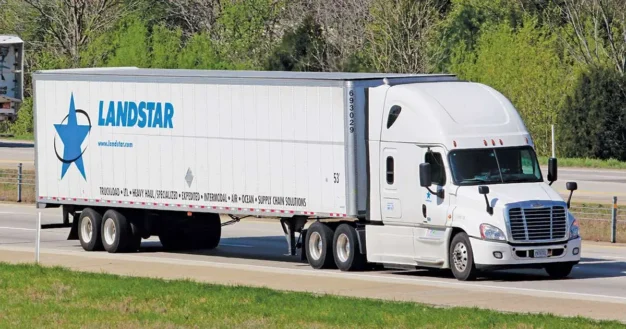
Jansson LLC is a Landstar freight agent with access to a nationwide carrier network — including LTL, volume LTL, partial truckload, and full truckload options across all 48 contiguous states.
Through the Landstar network, Jansson helps U.S. businesses run side-by-side cost comparisons across modes for their specific pallet counts and lanes, identify which shipments are consistently triggering linear foot penalties, and shift volume to the mode that produces the best combination of cost and service.
Contact Jansson LLC today. Let’s run the numbers on your lanes — and find out how much the linear foot rule is actually costing you.