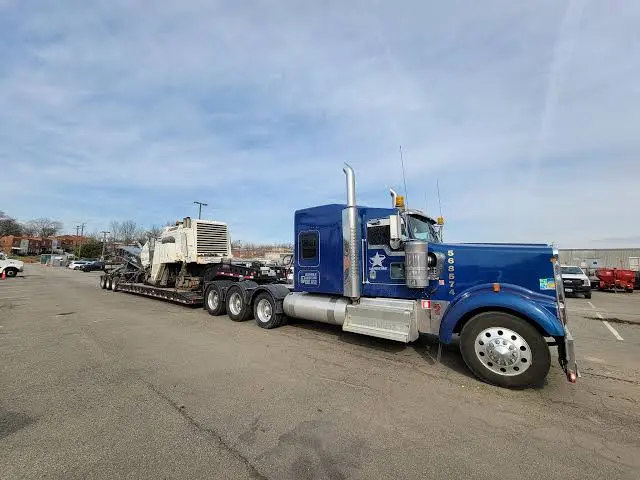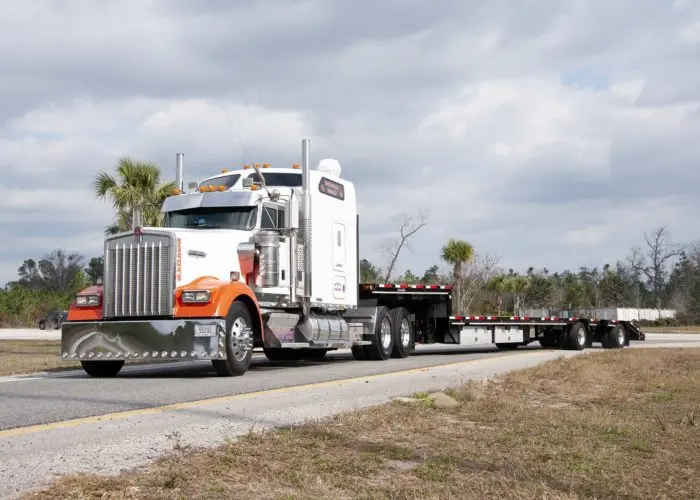
Flatbed freight does not always fit neatly within the boundaries of the trailer. Long steel beams, lumber, pipe, machinery, and building materials routinely extend beyond the front or rear of the vehicle — and every inch of that extension is governed by federal and state regulations that determine whether the load can legally move.
Trailer overhang regulations are intended to reduce crash risk and limit the consequences of large-truck incidents by keeping loads stable, visible, and controllable during transport. The FMCSA settled over 1,300 enforcement violation cases in 2025, totaling over $9.75 million in remittance from violating carriers. Federal civil penalties for violations of load securement and vehicle dimension regulations can reach $19,246 per violation.
For shippers moving long or irregular freight, understanding the overhang rules — and verifying that your carrier applies them correctly — is an essential compliance function.
The Federal Baseline: What 49 CFR Actually Says
The federal framework for cargo overhang is established in 49 CFR Part 393, with marking requirements specifically addressed in 49 CFR 393.87.
Rear Overhang
Under federal guidelines, rear overhang may extend up to 4 feet for non-divisible loads, unless state-specific rules require permits. This is the federal baseline — but it is not a universal national rule. States set their own rear overhang limits, and those limits vary considerably.
The federal baseline is mainly about safety marking for projecting loads, not one universal nationwide maximum overhang rule. FMCSA guidance under 49 CFR 393.87 addresses when projecting loads must be flagged or lighted, including rear projections of 4 feet or more.
Once a rear projection exceeds 4 feet, mandatory marking requirements apply — regardless of whether the load requires a permit. Loads that extend beyond the ends of the hauling vehicle must be marked with flags during daylight and red lights during night movement.
Front Overhang
Front overhang is generally limited to 3 feet, subject to state-specific regulations. Front projections present a different hazard than rear projections — they reduce the driver’s ability to judge the vehicle’s forward clearance in tight situations and create a strike risk for pedestrians and other vehicles at intersections.
Front overhang of three to four feet (depending on the truck and trailer combination) is permissible without a permit in most U.S. states at the federal baseline level. Beyond that threshold, state permit requirements apply.
Marking Requirements: Flags, Lights, and Signs
Proper marking is the compliance element most frequently missed — and most commonly cited — for overhang violations.
Flag Requirements
Flags are required to highlight loads exceeding standard dimensions: width more than 102 inches, rear overhang more than 4 feet, or front overhang more than 3 feet (varies by state). Use bright red or fluorescent orange flags, sized 18×18 inches, made of durable material like nylon or vinyl to withstand wind.
Flag placement follows specific rules based on overhang width. If the overhang is less than 2 feet wide, a single flag or light at the end of the overhang is required. If the overhang is more than 2 feet wide, the rear corners of the overhang should be marked with flags (and lights if required for night movement).
Flags must remain visible at 500 feet during daylight — torn or faded markers violate §393.87. A flag that was compliant at the start of a trip but becomes damaged or detached during transit creates a mid-trip violation. Pre-departure inspection and replacement of worn flags is a carrier responsibility — but a shipper who understands this requirement can verify compliance before the truck leaves the dock.
Night Movement Requirements
Warning lights are required for movement at night and during periods of reduced visibility. Warning lights should be either amber (forward and sides) or red (rear and rear overhangs) and should be visible for up to 500 feet. In some states, flashing or strobe lights are required.
A load that is marked correctly for daytime movement may not be compliant for night movement without additional lighting. Carriers who plan routes that include night driving segments on long-haul overhang loads must verify that their lighting configuration meets both the federal standard and any more restrictive state requirements along the route.
Oversize Load Signs
Overwidth shipments need side-mounted signs with 10-inch lettering. Overlength cargo requires additional flags spaced every 16 feet. The “OVERSIZE LOAD” sign — yellow background, black lettering, 7 feet by 18 inches — is required for loads exceeding specific dimensional thresholds that vary by state.
The State Variation Problem
Once you start moving state to state, the real compliance picture expands because each jurisdiction can set its own overhang, permit, and route rules. Companies that frequently ship goods using flatbed trailers need to be especially conscious of these laws. If you fail to adhere, it can lead to costly delays, especially if the overhanging loads cross state lines without meeting each state’s specific requirements.
This state variation is where multi-state overhang compliance becomes genuinely complex. A load that is legal in Texas — which has relatively permissive overhang allowances — may require a permit the moment it crosses into a state with stricter limits. A carrier who plans the route based only on the most permissive state’s rules is creating compliance exposure in every other state along the route.
Most states will allow operation of vehicles with banners and lights that vary from their requirements if the load markings comply with the requirements of the originating state. This, however, should be confirmed during the initial permitting process.
This provision provides some flexibility for multi-state moves — but “should be confirmed” is the operative phrase. Relying on the originating state’s marking as universally sufficient without verification is a compliance risk.
What to Verify Before an Overhang Load Moves
The pre-departure verification list for any load with significant front or rear overhang includes confirming the overhang measurement from the rearmost vehicle extremity — not from the axle — verifying flag and light requirements for each state on the route, confirming permit requirements for loads exceeding each state’s baseline, and documenting flag installation with timestamped photos before departure.
Document all installations with timestamped photos. That documentation provides evidence of compliance at the time of departure — which becomes relevant if a flag is lost during transit and an inspector writes a violation based on current condition rather than departure condition.
How Jansson LLC Helps U.S. Businesses Move Overhang Freight Compliantly
Overhang compliance across multiple states requires permit coordination, marking verification, and route planning experience that goes beyond standard flatbed operations.
Jansson LLC is a Landstar freight agent with access to a nationwide carrier network — including experienced flatbed and oversize operators who understand federal and state overhang requirements, marking standards, and the permit coordination that keeps overhang loads compliant across every state on the route.
Contact Jansson LLC today. Let’s make sure your long freight is marked correctly, permitted properly, and moving without overhang violations from origin to destination.