Industrial freight fails in transit for one of three reasons: the tiedown count was wrong, the working load limit calculation was wrong, or the tensioning was inadequate when the truck left the dock.
In 2025, CVSA recorded 18,108 citations for cargo that leaked, spilled, blew, or fell in transit — plus 16,054 citations for dunnage, chains, straps, tarps, or components that were themselves not secured to the vehicle. Every one of those 34,000-plus citations traces to a failure in one of three fundamentals: the aggregate working load limit, the force-vector retention standard, or the tiedown count formula.
Understanding how those fundamentals apply to synthetic webbing straps and chains — the two primary tiedown types for industrial goods — is what separates a compliant load from a citation.
The Foundation: Working Load Limit and the 50% Rule
Every tiedown used to secure cargo must carry a stamped or labeled working load limit. No marking means it does not count toward your securement calculation under FMCSA rules. This is exactly why consumer-grade straps fail commercial inspections — they are often unmarked or carry ratings that do not hold up against commercial load requirements.
The aggregate working load limit of all tiedowns securing a load must be at least 50% of the total weight of the cargo being secured under 49 CFR 393.106.
The math is straightforward. A 30,000-pound load requires an aggregate WLL of at least 15,000 pounds across all tiedowns. With four Grade 70 chains rated at 4,700 pounds WLL each, the aggregate is 18,800 pounds — sufficient for this example. With four straps rated at 3,333 pounds WLL each, the aggregate is 13,332 pounds — below the minimum, and a citation at the scale.
The calculation must be done before loading — not estimated by feel — and verified by the driver. An inspector has discretion to flag a load as inadequately secured even when the minimum count has been met, if the load shows signs of movement or improper placement.
Synthetic Webbing Straps: Capabilities and Limitations
Straps are the most versatile and widely used tiedown in flatbed freight — but they are not appropriate for every load type or weight class. Understanding where they excel and where they fall short is what determines whether a strap-based securement system will hold up to an inspector’s review and a highway’s forces.
What Straps Do Well
Synthetic webbing straps — ratchet straps and cam buckle straps — are the most common tiedown for flatbed industrial freight under 25,000 pounds. They are lightweight, easy to apply, and sufficiently rated for a wide range of cargo when correctly specified.
Each individual strap must be marked with its WLL. Professional-grade tiedown straps carry clear WLL markings and are built to meet or exceed the rated capacity on the label. The aggregate WLL calculation uses the stamped WLL — not the breaking strength, which is typically three times higher.
The Angle Problem
A strap running at a steep angle loses effective tension. The force a tiedown contributes to the securement system is a function of both its rated WLL and the angle at which it applies force to the cargo. A strap angled steeply from the anchor point to the cargo contributes less effective horizontal restraint than one running nearly horizontal.
This angle loss is where many industrial securement calculations fail — the aggregate WLL meets the 50% rule on paper, but the effective restraint is lower because of the geometry. Flatter strap angles produce better securement efficiency.
When Straps Are Not Sufficient
For heavy industrial goods — steel components, machinery, pipe bundles, or any cargo approaching or exceeding 25,000 pounds — chains provide significantly higher WLL per tiedown and greater resistance to the abrasion risk that edges and irregular surfaces create.
Damaged webbing, frayed synthetic straps, or any strap with cuts count as zero WLL under FMCSA rules. A single damaged strap on a load can drop the aggregate below 50% and generate an out-of-service order for the entire vehicle.
Chain Tensioning for Industrial Goods
Chains are the standard for the heaviest and most demanding industrial loads — but their effectiveness depends entirely on correct grade selection, compatible binder ratings, and proper tensioning protocol. A chain that is correctly specified but incorrectly tensioned fails the performance standard just as surely as one that was undersized from the start.
Chain Selection and Grade
Chains are the preferred tiedown for heavy industrial cargo. The relevant grades for cargo securement are Grade 70 — the transport chain standard, with 4,700 pounds WLL for 5/16-inch chain — and Grade 80 and Grade 100, which provide higher WLL in the same chain diameter and are appropriate for the heaviest loads.
Binders are also rated and marked, and are required to meet the minimum standard of the working load limit of the chain you are using. A Grade 70 chain with a Grade 43 binder is not a compliant combination — the binder is the weak link in the system and limits the effective WLL to its own rating, not the chain’s.
Tensioning Protocol
Chain tensioning is where technique directly affects compliance. A chain that appears tight at loading may lose tension as the cargo settles during the first miles of transit — which is exactly why FMCSA requires re-inspection within the first 50 miles, then every 150 miles or 3 hours thereafter.
The 50-mile initial re-inspection exists because cargo often settles and shifts during the first portion of a trip as it adjusts to road vibration and load distribution. Catching a shift early — before it becomes a full violation — is the purpose of this requirement.
Loose chains or damaged chains should always be inspected and replaced if necessary. A chain with visible wear, deformed links, or damaged hooks has a compromised WLL — and under 49 CFR 393.104, damaged devices count as zero WLL.
The Edge Protection Requirement
When tiedowns run over cargo edges with a radius of less than half an inch, edge protection is required to prevent abrasion damage to the strap or chain. Edge protectors — plastic or rubber sleeves that fit between the tiedown and the cargo edge — are mandatory, not optional, for sharp-edged industrial cargo.
Missing edge protection is treated as a damaged securement device because the strap is compromised at the contact point. An inspector who sees a strap contacting a sharp steel edge without edge protection will write the violation regardless of whether the strap appears intact.
The Tiedown Count Formula
The number of tiedowns required depends on both the length and weight of the cargo — not weight alone. The general formula requires one tiedown for cargo under 5 feet long and under 500 pounds, two tiedowns for cargo between 5 and 10 feet, and one additional tiedown for every additional 10 feet of length.
These are minimums. Heavier or unstable loads may require more. For machinery, anything less than 10,000 pounds requires one tiedown in the front and one in the rear. Above that threshold, the aggregate WLL calculation — not just count — governs whether the securement system meets the standard.
How Jansson LLC Helps U.S. Businesses Move Industrial Goods Safely
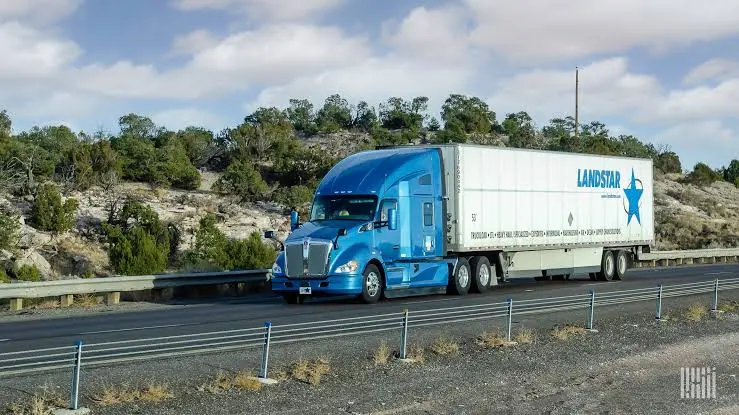
Strapping and chain tensioning compliance starts with the carrier — but the shipper has a direct interest in working with carriers who apply these standards correctly on every load.
Jansson LLC is a Landstar freight agent with access to a nationwide carrier network — including experienced flatbed and specialized freight operators who understand FMCSA cargo securement requirements, commodity-specific protocols, and the tensioning practices that keep industrial freight compliant from pickup to delivery.
Contact Jansson LLC today. Let’s make sure your industrial freight is moving with a carrier whose securement practices match the standard your cargo — and your customers — require.