
Straight cargo theft makes headlines. Pilferage does not — and that is exactly what makes it so costly.
Cargo theft losses hit $725 million in 2025, with the average stolen shipment valued at $273,990. But those figures undercount the problem. Pilferage involves taking smaller portions of a shipment from a trailer, often during transit or at transfer points. Because the full load is not missing, these practices can go undetected until the carrier delivers and the receiver counts the inventory.
65.3% of motor carriers surveyed had experienced cargo theft at some point, and 43.2% reported an incident in 2023 alone. For LTL shipments — which pass through four to five terminal handling events and change hands multiple times — each transfer point is an opportunity for pilferage that a dedicated truckload move does not create.
The good news: pilferage is highly responsive to packaging-level countermeasures. Here is what actually works.
Why LTL Is Particularly Vulnerable to Pilferage
In a dedicated truckload, your freight is the only freight. It loads at origin and unloads at destination — two handling events, one team, minimal exposure.
In LTL, your freight shares trailers with dozens of other shippers’ goods across multiple transfer points. At each terminal, pallets are broken down, sorted, and reloaded — often in high-volume, time-pressured environments where supervision is limited.
For cargo pilferage, criminals steal small amounts of cargo from a vehicle. Often, they fraudulently edit the bill of lading to make the theft more difficult to detect. The crime can be difficult to identify and prosecute because shippers often struggle to identify the point at which the goods disappeared after the fact.
That identification problem is the core vulnerability. When the theft is not discovered until delivery, the chain of custody is too long to pinpoint where the loss occurred — which makes claims difficult, recovery unlikely, and prevention the only effective strategy.
Security Tape: Making Tampering Visible
Security tape — also called pilfer-proof tape or tamper-evident tape — is one of the most cost-effective anti-pilferage tools available for LTL shipments.
How Security Tape Works
Standard packaging tape can be removed and reapplied without visible evidence. Security tape cannot. When removed, it leaves a void pattern — “OPENED” or “VOID” — permanently printed on both the tape and the surface it was applied to. The tampering is immediately visible to anyone who looks.
This visible deterrent serves two functions. It discourages opportunistic pilferage because the evidence of tampering cannot be concealed. And it provides documentation evidence when a claim is filed — the intact security tape at origin and the void pattern at destination establish that tampering occurred during transit.
Where to Apply Security Tape
Apply security tape across every carton seam — top flaps and side seams — before the carton is placed on the pallet. For palletized loads, apply tape across pallet-to-carton interfaces where individual cartons could be removed without disturbing the stretch wrap.
High-value items such as designer clothing, jewelry, electronics, and luxury accessories are prime targets for pilferage. For these commodities, security tape should be applied to every individual carton — not just the outer layer visible through the stretch wrap.
Black Shrink-Wrap: Concealing What Is Inside
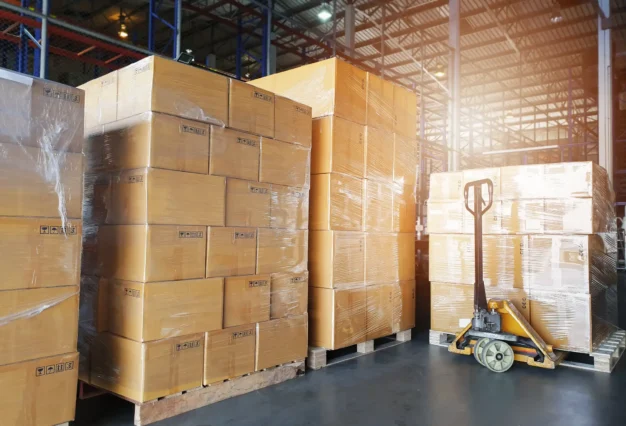
Standard clear stretch wrap protects freight physically — but it also advertises its contents to anyone who looks at the pallet. A clear-wrapped pallet of electronics, pharmaceutical products, or branded consumer goods announces its value to every terminal worker who handles it.
What Black Shrink-Wrap Does
Black stretch film conceals the contents of a pallet entirely. From the outside, a black-wrapped pallet looks like a pallet. The commodity, brand markings, and individual product packaging are invisible.
This concealment removes the primary trigger for opportunistic pilferage — the visual identification of a high-value or easily resold commodity. A thief who cannot see what is inside a pallet is less likely to target it than one who can read the brand name through clear film.
Black shrink-wrap provides the same structural protection as clear film — the same containment force, the same pallet-to-load bonding, the same multiple-pass application standard. The only difference is what it reveals — or does not reveal — about the contents.
When Black Shrink-Wrap Is Most Valuable
Black shrink-wrap is particularly effective for electronics, pharmaceuticals, luxury goods, alcohol, tobacco, and any commodity with high street value and easy resale. These are the categories that consistently appear at the top of cargo theft target lists.
Electronics, food and beverages, pharmaceuticals, and auto parts top the list of stolen freight in the United States. Alcohol, tobacco, and household goods are also common targets, along with metal, which saw a sharp increase in theft incidents in 2025.
If your freight falls into any of these categories, black shrink-wrap is a packaging investment that costs pennies per pallet and removes your freight from the visual targeting that drives most terminal-level pilferage.
Pallet Strapping: Making Individual Carton Removal Difficult
Stretch wrap alone allows determined thieves to cut the film, remove individual cartons, and re-wrap the pallet with film carried for the purpose. Pallet strapping adds a layer of physical security that is significantly harder to defeat inconspicuously.
Strapping as an Anti-Pilferage Measure
Polypropylene or steel strapping bands applied over the stretch wrap create a physical barrier around the load. Removing a carton from a strapped pallet requires cutting the strap — which leaves visible evidence and takes more time than a quick cut-and-rewrap of stretch film.
Simple physical controls still work: high-security locks, verified and photographed seals at pickup and after each stop, and parking trailers with doors against a wall reduce opportunistic pilferage. Strapping is the pallet-level equivalent of those controls — a physical barrier that raises the effort and evidence required to commit pilferage.
Apply strapping in addition to — not instead of — stretch wrap. Two horizontal bands around the load perimeter, positioned to cross carton seams where individual boxes could otherwise be removed, provide the most effective coverage for anti-pilferage purposes.
Documentation at Pickup
Photograph every strapped, wrapped pallet before pickup — showing the security tape intact, the black shrink-wrap applied, and the strapping in place. That photo documentation establishes the condition of the freight at origin and becomes critical evidence when a pilferage claim is filed.
Verified and photographed seals at pickup and after each stop are standard practice for high-value loads — and the same discipline applied at the pallet level provides equivalent protection for LTL freight.
How Jansson LLC Helps U.S. Businesses Move High-Value LTL Freight Safely

Packaging countermeasures protect your freight from pilferage. Carrier selection determines the handling environment those measures operate in.
Jansson LLC is a Landstar freight agent with access to a nationwide carrier network — providing U.S. businesses with LTL routing options, carrier selection, and freight coordination across multiple lanes and regions.
Through the Landstar network, Jansson helps U.S. businesses select carriers based on safety and claims performance records — not just rate — ensuring high-value freight moves with carriers who take security seriously at every terminal handling event.
Contact Jansson LLC today. Let’s make sure your LTL freight is moving with the right carrier — and arriving with everything that was loaded.